
Why plates
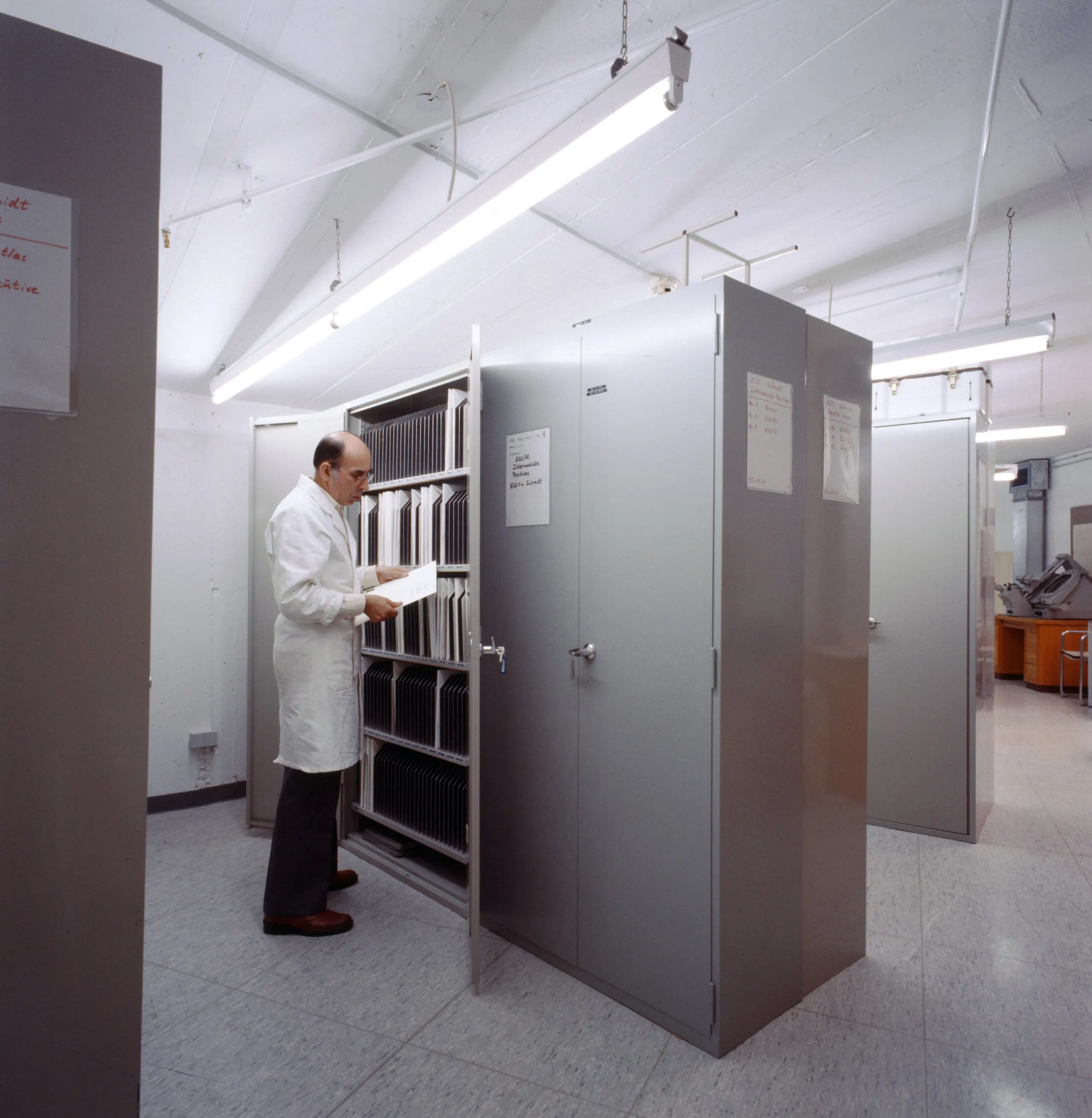
Before digital cameras, professional astronomers recorded the sky on glass plates coated with photographic emulsion. Between the 1880s and the 1990s, observatories around the world exposed millions of them. They are the only record we have of how much of the sky looked during that century.
Harvard College Observatory holds one of the largest collections, with plates taken between 1885 and 1992. Its DASCH project (Digital Access to a Sky Century @ Harvard) finished scanning them in 2024 and has made the scans and calibrated catalogs public. That is the data we work with.

What we do
When software looks for stars on a scanned plate, it also finds many things that are not stars: grains and bubbles in the emulsion, dust, scratches, the edge of the plate, and marks made in ink by the people who used it. DASCH’s pipeline already deals with most of these. We focus on the detections that are still hard to sort, and ask how well a simple, open image classifier can help.
In the first phase, which ended in October 2026, we:
- labeled 14,600 cutouts from 312 plates, each checked by two members,
- trained a classifier that agrees with human reviewers 93 percent of the time, and
- published a catalog of about 41,000 classified detections from 1,200 plates.
The details are in ASRU-TN-2026-003.
What comes next
Phase two will extend the classifier to more plate series, add a class for plate flaws that repeat across many plates from the same batch of emulsion, and test whether the catalog can help clean up long-term light curves of variable stars.
Taking part
Labeling sessions are open to all members and need no background in astronomy. Each session starts with a short guide and a practice set. If you are not a member yet, see how to join.
Acknowledgment
This program uses data provided by Digital Access to a Sky Century @ Harvard (DASCH). The DASCH project at Harvard is grateful for partial support from NSF grants AST-0407380, AST-0909073 and AST-1313370. ASRU is not affiliated with Harvard or the DASCH project.